
Memorizing the Quran is one of the most rewarding acts a Muslim can pursue. Yet most people who want to learn how to memorize Quran fast are not short on motivation. They are short on method. This guide gives you the exact techniques, daily routines, and revision habits used by students who complete their Hifz successfully through a structured Quran memorization course. Here is a quick snapshot of what works: fix your Tajweed before rushing in; use the Takrar method (10-20 reads looking at the Mushaf, then 10 from memory per verse); stick to one Mushaf throughout to build visual memory; always memorize out loud, never silently; use the Fajr window for new memorization when the brain is sharpest; connect each verse to its meaning before drilling; apply spaced repetition (revise on Day 2, Day 5, Day 10 of first learning); and never skip Muraja’ah (daily revision), because what you memorize without revising will not stay. Every one of these habits is explained fully below.
What Does “Memorizing Quran Fast” Actually Mean?
Fast Quran memorization means acquiring and retaining Quranic verses at a consistent pace through structured technique and disciplined revision, without sacrificing Tajweed or accuracy.
Many students confuse speed with rushing. A student who covers a page in 20 minutes but loses half of it by the next morning has not memorized fast. They have memorized carelessly. Real speed in Hifz comes from using a method that makes each verse stick deeply on the first attempt, so you are not repeating the same verses for weeks. Dr. Yahya Al-Ghawthani, one of the most respected contemporary scholars on Hifz methodology, observed across decades of teaching that the fastest students were not the ones who spent the most hours, but the ones who applied the most effective method, consistently. His findings align closely with what cognitive science now confirms about how human memory actually works.
“The best of you are those who learn the Qur’an and teach it.” — The Prophet Muhammad (peace be upon him), Sahih al-Bukhari 5027
Fix Your Tajweed First: The Shortcut Most Students Skip
Tajweed refers to the set of rules governing the correct pronunciation of every letter and word in the Quran, including Makharij (the precise articulation point of each Arabic letter), Madd (elongation of certain vowels), Ghunnah (nasalization through the nose), and Idghaam (merging of letters). Memorizing without correct Tajweed means encoding errors directly into memory, and unlearning an incorrect verse is far harder than learning it right the first time.
Before starting a new Surah or Juz, spend 15 minutes listening to a qualified Qari recite that portion while following along in your Mushaf. Confirm any letter or word you are unsure about. If you are still building your Tajweed foundation, our Noorani Qaida course teaches you to learn Tajweed from scratch before you begin Hifz. This preparation saves hours of re-learning later. Imam Ibn al-Jazari (1350-1429 CE), whose two foundational texts Al-Muqaddimah al-Jazariyyah and Al-Nashr fil-Qira’at al-‘Ashr remain authoritative today, ruled that reciting the Quran with correct Tajweed is a religious obligation for every capable Muslim. Memorization built on correct Tajweed is structurally far more durable.
The Principles Behind Fast Hifz: What Cognitive Science Confirms.
Cognitive science has identified three memory strategies that consistently outperform traditional rote learning in controlled studies. At Apex Quran Academy, these three principles are integrated into every student’s Hifz plan from the first session, because they align perfectly with how the Quran has been transmitted and preserved for over 1,400 years.
The Apex Active Recall Method
Active Recall is the practice of retrieving information from memory without looking at the source, rather than passively re-reading. A 2011 study by Roediger and Butler published in Trends in Cognitive Sciences confirmed that retrieval practice produces dramatically stronger long-term retention than passive review. In Hifz, this means: after reading a verse in the Mushaf, close the book and recite from memory before moving on. Every time you close the book and retrieve the verse, you are strengthening the neural pathway. A student who reads a verse 30 times with the book open will remember it far less reliably than one who reads it 10 times looking and tests themselves 10 times from memory.
The Apex Spaced Repetition Schedule
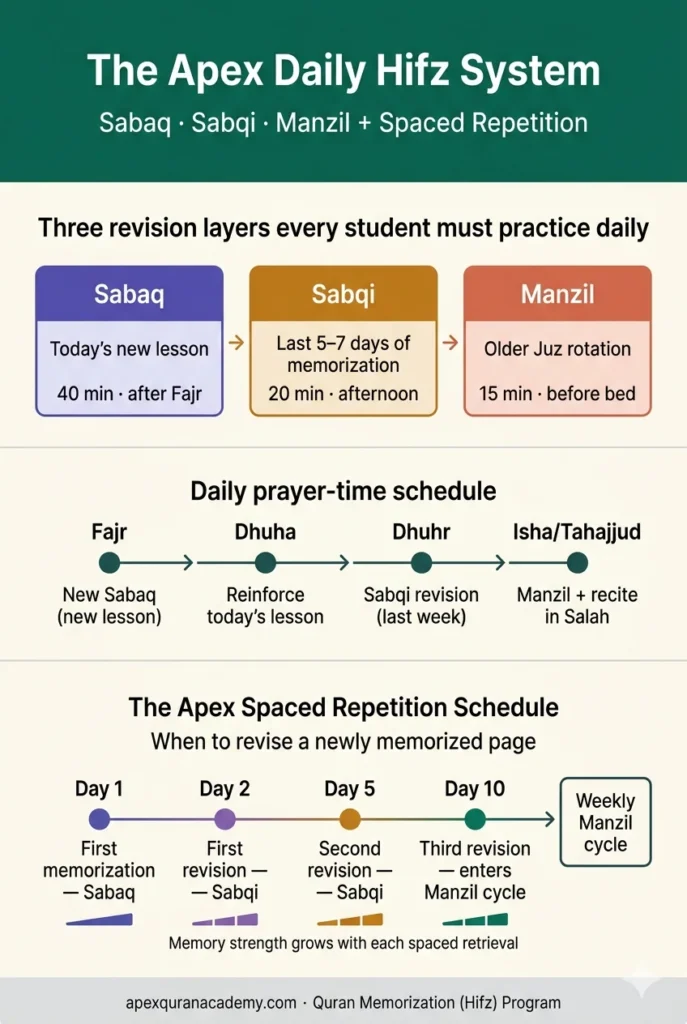
Spaced Repetition means reviewing memorized material at increasing time intervals before the memory fades, rather than revising everything daily. The concept was first formalized by Hermann Ebbinghaus in the 1880s through his discovery of the “forgetting curve,” which shows that memories decay rapidly unless reinforced at the right moments. A 2008 study by Cepeda et al. in Psychological Science confirmed that spacing reviews at optimal intervals improves retention by 200 to 400 percent compared to massed practice. Applied to Hifz: if you memorize a page on Day 1, revise it on Day 2, again on Day 5, and again on Day 10. Each successful retrieval at a longer gap makes the memory progressively more durable. Students who skip spaced revision and instead revise the same page daily for three days are doing far less useful work for the same time investment.
The Apex Meaning-Based Encoding Approach
Self-Explanation, or meaning-based encoding, involves connecting new information to something the learner already understands before memorizing it. Research from cognitive psychology consistently shows that information tied to meaning is retained far longer than information learned as pure sound. In Hifz, this means reading a brief translation of the verses you plan to memorize before your repetition session. Even 2 minutes reading a reliable English translation like Sahih International, or consulting a simple Tafsir such as Tafsir Ibn Kathir gives your brain a second anchor for each verse alongside the sound. When one anchor weakens, the other supports recall.
4 Traditional Techniques That Apply These Principles.
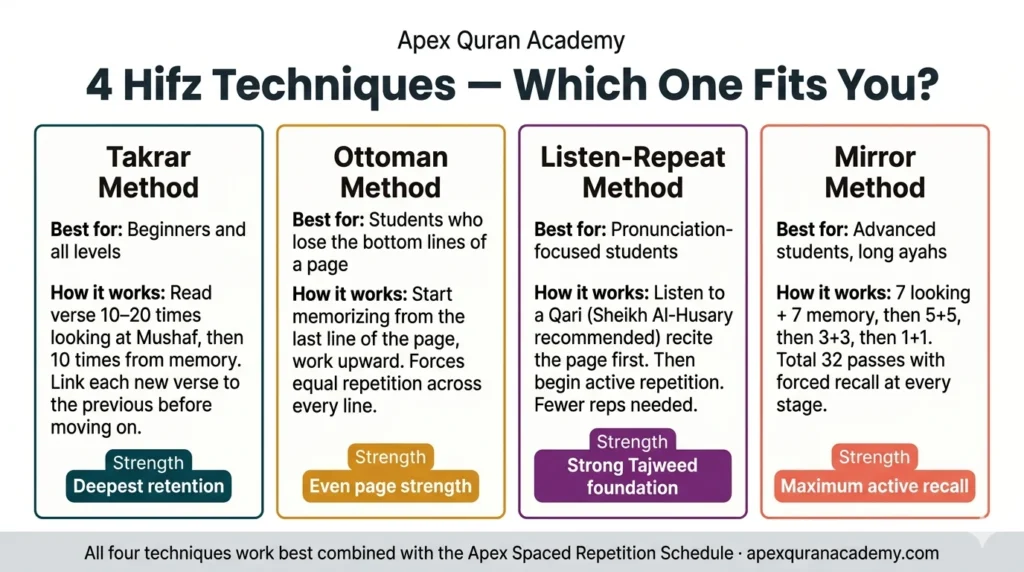
Beyond the three science-backed methods above, these four traditional Hifz techniques have been refined across centuries of practice. Each has a specific strength. Try them and build your core routine around the one that fits best.
1. The Takrar (Repetition) Method
Takrar means repetition, and it is the foundation of nearly every classical Hifz program. Takrar works like this: read a verse while looking at the Mushaf 10 to 20 times, then close the book and recite it from memory 10 times. If you stumble, open the book, find the missed word, close the book, and keep going. Once that verse is solid, link it to the verse before it and recite both together before moving forward. This linking step is where most students cut corners, and it is precisely where most forgetting begins.
2. The Ottoman (Bottom-to-Top) Method
This technique, used for centuries in Turkish and Central Asian Hifz schools, starts memorization from the last line of a page and works upward. Most students always begin at the top, so the early lines receive far more repetition than the bottom ones. Those weak bottom lines break first during revision. The Ottoman method forces every line to receive equal attention from the start. When you later revise from top to bottom, everything holds up uniformly.
3. The Listen-Read-Repeat Method
Before any repetition session, listen to the page you plan to memorize being recited by a qualified Qari while following along in your Mushaf. Do not attempt to memorize at this stage. Simply allow the sounds and text to enter your mind together. When active repetition begins afterward, the verse is already partially familiar, so fewer repetitions are needed to reach full retention. Sheikh Mahmoud Al-Husary (1917-1980) is widely recommended for this purpose because of his slow, meticulous Tajweed-precise recitation. His recordings are freely available at various online Quran platforms.
4. The Mirror (Decreasing Repetition) Method
This method applies active recall in decreasing cycles. Recite a verse while looking 7 times, then from memory 7 times. Then 5 looking and 5 from memory. Then 3 and 3. Then 1 and 1. That totals 32 passes over a single verse, with forced memory retrieval built into every round. If the verse is particularly difficult, begin higher, at 9 or 11, and work down. The forced recall at each stage is what makes this especially effective for longer or more complex ayahs.
Tips to Memorise Quran Fast: Daily Habits That Make the Difference
Technique alone is not enough. These habits are what separate students who make steady progress from those who feel stuck at the same point for months.
- Use one Mushaf throughout your entire Hifz journey. Your brain builds a visual map of each page, remembering not just the words but where they sit. Switching Mushafs erases those visual anchors. Use the standard 15-line Medina Mushaf print for consistency, since it is the most widely available in the same format globally.
- Memorize out loud, always. Silent reading uses one memory channel. Reciting aloud engages your auditory and motor memory simultaneously, creating two reinforcing traces. Even a quiet but clear whisper is significantly more effective than reading silently.
- Use the Fajr window for new memorization. The post-Fajr period is your most cognitively sharp window. Reserve it for Sabaq (new lesson) and move Sabqi and Manzil revision to later in the day.
- Connect to meaning before drilling. Read a brief translation of the passage before repeating it. Even a 2-minute read of Sahih International gives your brain a second anchor alongside the sound, which significantly reduces forgetting when one anchor weakens.
- Record and listen back. Record a full page recitation on your phone at the end of each session. Listen once and compare it against Sheikh Al-Husary. Errors invisible in the moment become obvious on playback. Correct one or two points per session, not everything at once.
- Revise in Salah. Reciting recently memorized material in prayer encodes it differently from a desk session. The focus and spiritual presence of Salah lock the memory in more deeply. Use Sunnah and night prayers to rotate through recent pages.
How to Memorize Quran Easily in 5, 30, and 60 Minutes: A Practical Guide
Time is the most common obstacle to consistent Hifz. Below is a structured breakdown of how to approach one page of the standard Medina Mushaf (approximately 15 lines, 5-7 ayahs) depending on how much time you have.
| Session | 5 Minutes | 30 Minutes | 60 Minutes |
| Goal | Familiarity only | Working retention | Deep, durable Hifz |
| Method | Listen + read aloud once | Takrar per section (10+10) | 20-20 method per verse |
| Structure | 5 sections, read opening word of each ayah from memory | 5 sections x 3 lines, link sections after each | Listen once, then verse-by-verse, connect every 2 |
| Finish with | Recall first word of each verse | Recite full page once from memory | Recite full page 3 times + use in Salah |
| Best for | Preparation before a full session | Intermediate students | Serious daily Hifz students |
A note on the 20-20 method used in the 60-minute session: this means 20 reads while looking at the Mushaf and 20 recitations from memory for each individual verse, before moving to the next. It is slower than most students expect, but it produces memorization that does not require constant heavy revision to maintain.
How to Memorize Quran Easily: The Role of Intention and Environment
The best way to memorise Quran easily is to reduce friction at the start of every session. Friction is anything that makes sitting down harder: a noisy environment, a phone nearby, uncertainty about which page to start on, or a revision backlog that feels overwhelming.
Set everything up the night before. Know which page you are memorizing tomorrow. Have your Mushaf open to that page. Set your alarm for Fajr with no snooze option. Keep your phone in another room during the session. These are small decisions, but they remove the hesitation that costs many students 10 to 15 minutes of their most productive window every single morning. Over a year, that lost time adds up to weeks of missed memorization.
How to Revise Memorized Quran: The Muraja’ah System
Muraja’ah means revision, and it is not optional. It is the central work of Hifz. Without structured Muraja’ah, even deeply memorized pages fade. The Prophet Muhammad (peace be upon him) said: “Keep refreshing your knowledge of the Quran, for by the One in Whose hand is my soul, it escapes from the heart faster than a camel from its rope.” (Sahih al-Bukhari, Hadith 5032)
The classical Hifz system divides daily revision into three layers. Sabaq is the new lesson for the day. Sabqi is recent revision of the last 5 to 7 days of memorization, the portion most at risk of fading. Manzil is cumulative revision of older material, cycling through Juz memorized weeks and months earlier. A practical daily structure: 40 minutes after Fajr for Sabaq, 20 minutes in the afternoon for Sabqi, 15 minutes before bed rotating through Manzil across the week.
Apply the Apex Spaced Repetition Schedule to Muraja’ah: revise a new page on Day 2, Day 5, and Day 10 after first memorizing it. After Day 10, it moves into your weekly Manzil cycle. Students who follow this schedule consistently rarely lose older material entirely.
How to Memorize 2 Pages of Quran a Day
Two pages a day means completing all 604 pages of the standard Medina Mushaf in roughly one year. It is ambitious but achievable with two structured sessions. Memorize the first page after Fajr. Take a full break. Memorize the second page after Dhuhr. Revise both new pages plus the previous day’s material in the evening. Never push new memorization ahead by skipping revision. Losing three old pages to gain two new ones is not progress.
Research in cognitive science (Cepeda et al., 2008) consistently shows that combining meaning-based understanding with structured repetition produces significantly stronger retention than repetition alone. That is the difference between students who memorize 2 pages and keep them, and those who memorize 2 pages and slowly erode their earlier work. Connect meaning to your daily Sabaq, even briefly, and your revision load will stay manageable.
Children vs. Adults: How Quran Memorization Approach Differs
The memorization journey looks different depending on age. Here is a clear side-by-side comparison to help you plan the right approach.
| Factor | Children (Ages 6-14) | Adults (16+) |
| Best time | After Fajr + short after-school session | Post-Fajr only (protect this window) |
| Session length | 20-30 minutes max | 30-45 minutes per session |
| Daily target | 5-10 ayahs or half a page | Half to one full page |
| Key strength | Fast audio memory, picks up sounds easily | Stronger comprehension, meaning anchors help |
| Main challenge | Short attention span, needs variety | Time pressure, needs fixed daily slot |
| Revision style | Frequent short bursts across the day | Dedicated Muraja’ah block in evening |
| Start with | Juz Amma (short Surahs) | Juz Amma, then continue backward |
| Teacher needed? | Yes, essential for Tajweed from the start | Yes, especially for Tajweed correction early |
For sisters looking for a female-only environment, our online Hifz program for women pairs every student with a certified Hafiza teacher.
The Role of a Qualified Teacher in Faster Hifz
Everything in this guide can be practiced independently. But there is a ceiling to solo Hifz that most self-learners eventually reach. A qualified teacher does three things no technique or app can replace: they catch Tajweed errors in real time before those errors get encoded into memory; they provide accountability that makes daily consistency far more likely; and they design a personalized Sabaq-Sabqi-Manzil plan around your actual pace rather than an ideal one.
For Muslims in the US, UK, and Canada who cannot find a qualified Hifz teacher nearby, Apex Quran Academy offers one-on-one online Hifz programs with certified teachers who hold Ijazah in Quran recitation. Sessions are scheduled around your timetable and begin with a structured plan from the first class.
Frequently Asked Questions
What is the best way to memorize Quran easily for beginners?
Start with Juz Amma (the 30th Juz). Use the Listen-Read-Repeat method to build familiarity before drilling. Apply Takrar (10 reads looking, 10 from memory) per verse and connect each new verse to the previous one before moving forward. Keep sessions to 30 minutes daily without gaps. Short, consistent sessions outperform long, irregular ones at every level.
What are the tips to memorize Quran fast without forgetting?
Three habits prevent forgetting more than any other: deep initial repetition (minimum 20 passes per verse before moving on), immediate linking of each new verse to those before it, and Muraja’ah within 24 hours of first memorization. The window between learning a verse and the following morning is when most forgetting happens. Revise before sleep and again after Fajr to close that gap.
How to memorize 2 pages of Quran a day without losing old material?
Two sessions: first page after Fajr, second after Dhuhr. Revise both new pages plus the previous two days’ material each evening. Never trade revision for new memorization. Protect Muraja’ah first, always.
How to revise memorized Quran without burning out?
Use the three-layer Muraja’ah system: Sabaq (new), Sabqi (last week), Manzil (older). Keep Manzil light but consistent. Ten minutes of flowing recitation through an older Juz is enough to keep it strong. Rotate all memorized Juz across the week rather than trying to go deep on everything every day.
Is it better to memorize slowly and carefully or quickly?
Slowly and carefully, always. A verse memorized deeply in 20 minutes will stay for years. A page rushed through in 15 minutes may be gone by the next afternoon. The goal of Hifz is not to reach the end of the Quran. It is to hold every page of it permanently. Reach that goal at the pace your memory genuinely needs.
Ready to start your Hifz journey with a structured plan and a qualified teacher? Apex Quran Academy offers personalized one-on-one Quran memorization programs for students of all ages and levels, available online for Muslims in the US, UK, and Canada. Learn more
By Hafiz Muhammad Hamza, PhD in Islamic Jurisprudence