
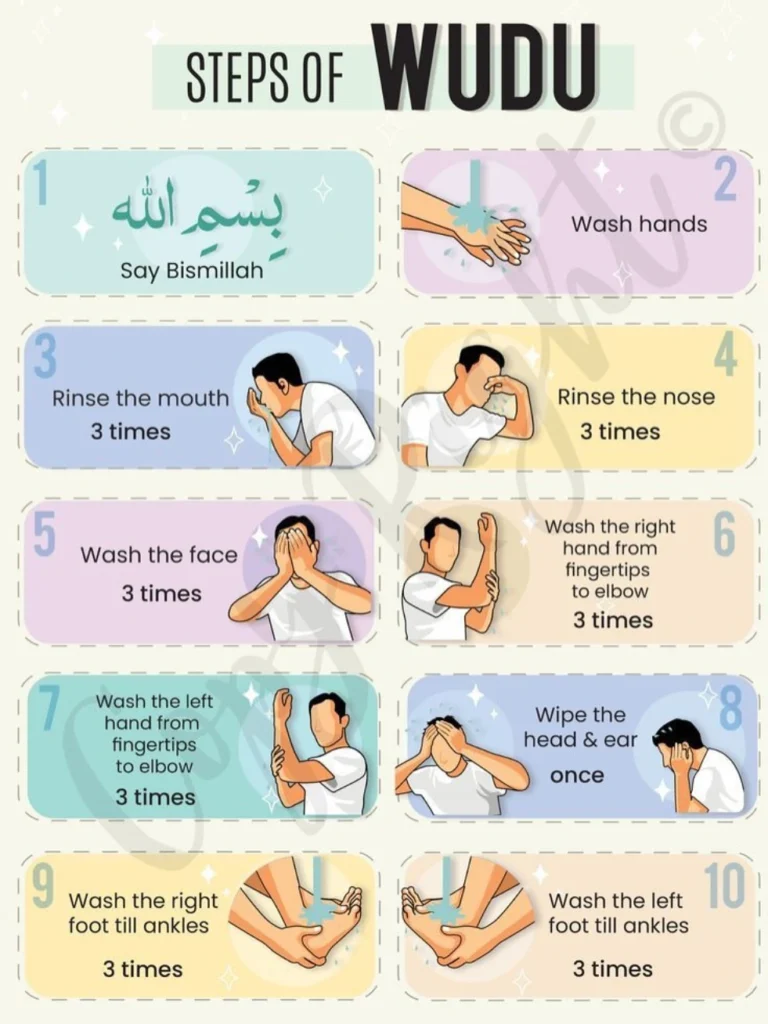
Wudu step by step is the Islamic ritual purification performed before prayer. In short: wash your hands, rinse your mouth and nose, wash your face, wash your arms to the elbows, wipe your head, and wash your feet — in that order, with intention. That is Wudu.
Before a Muslim stands in prayer, something must happen first. Not just physically, but inwardly. That thing is Wudu, the ritual purification that Islamic tradition places at the very threshold of worship. Every day, across five continents and a dozen time zones, hundreds of millions of Muslims walk to a sink, a tap, or a water vessel and perform the same sequence of actions. The words they say, the order of washing, the body parts they clean, the intention they hold in their hearts: all of it traces back to a single source, the Quran and the practice of the Prophet Muhammad (peace be upon him).
This guide covers everything: what Wudu means, why it matters, the precise distinction between its obligatory and recommended acts, how to perform it correctly, what invalidates it, and answers to the practical questions that Muslims living in Western countries ask most often. Whether you are new to Islam, teaching a child, or simply want to deepen your understanding of something you have done thousands of times, read on.
The Meaning and Importance of Wudu in Islam
Wudu is a ritual act of ablution in Islam that purifies the body before worship, performed by washing the hands, mouth, nose, face, arms, head, ears, and feet in a specific order using clean water.
The word “Wudu” comes from the Arabic root that carries the meaning of beauty and cleanliness. In Islamic practice, it refers to a specific form of ritual purification that prepares a believer to stand before Allah in prayer. Wudu is one of the most important acts in a Muslim’s daily life because the validity of Salah depends on it. The Prophet Muhammad (peace be upon him) said: “The prayer of a person who does not perform ablution is not valid.” (Sahih Muslim)
Understanding Taharah (طهارة), Hadath Asghar, and Hadath Akbar
To understand Wudu fully, you must first understand the concept it serves. Taharah (طهارة) is the Arabic word for ritual purity, a state of cleanliness required before certain acts of worship. It is not merely physical hygiene; it is a legal-spiritual condition recognized by Islamic jurisprudence (Fiqh) as a prerequisite for prayer, touching the Mushaf, and performing Tawaf. The Prophet (peace be upon him) said: “Tahoor (purification) is half of faith.” (Sahih Muslim)
Classical scholars divide ritual impurity (Hadath) into two categories:
• Hadath Asghar (Minor Impurity): This is the state that breaks Wudu. It is caused by passing wind, urinating, using the toilet, falling into deep sleep, or similar acts. One returns to Taharah by performing Wudu.
• Hadath Akbar (Major Impurity): This is a deeper state of ritual impurity, known as Janabah, requiring a full ritual bath (Ghusl). It is caused by sexual intercourse, ejaculation, the end of menstruation (Hayd), or post-natal bleeding (Nifas). Wudu alone is insufficient to lift Hadath Akbar.
Wudu is the prescribed remedy for Hadath Asghar. It restores Taharah, unlocks the door to Salah, and, according to the hadith, washes away minor sins with each drop of water that leaves the body.
Physical Cleanliness and Spiritual Purification
Wudu works on two levels at the same time. On the physical level, it keeps the body clean, which is something Islam strongly encourages. On the spiritual level, it removes minor sins and prepares the heart for worship. The Prophet (peace be upon him) said that when a Muslim washes his face during Wudu, every sin he looked at with his eyes is washed away with the water, and this continues for each body part that is washed (Sahih Muslim, Hadith 244). This is why Muslims around the world perform Wudu not just as a rule to follow, but as a meaningful act of faith.
The Evidence for Wudu in the Quran and Sunnah
The obligation of Wudu is clearly stated in the Quran. Allah says in Surah Al-Ma’idah (5:6):
O you who have believed, when you rise to perform prayer, wash your faces and your hands to the elbows and wipe over your heads and wash your feet to the ankles.” (Surah Al-Ma’idah, 5:6)
This single verse lays out the fard (obligatory) acts of Wudu. On top of this, the Sunnah of the Prophet (peace be upon him) gives us additional details about the recommended way to perform each step, including washing three times, starting with the right side, and reciting Bismillah before beginning.
Wudu of the Prophet (Peace Be Upon Him): The Most Authoritative Account
Before learning the steps of Wudu, every Muslim should know the most cited and most authoritative narration on this subject. It comes through Humran, the freed slave of Uthman ibn Affan (RA), recorded in both Sahih al-Bukhari (Hadith 164) and Sahih Muslim (Hadith 226) — the two most rigorously authenticated hadith collections in Islam.
Humran narrated: Uthman ibn Affan (RA) called for water and poured it over his hands three times and washed them. Then he put his right hand into the vessel, rinsed his mouth and sniffed water into his nose. Then he washed his face three times, and his arms to the elbows three times, then wiped his head, then washed each foot three times. After completing this, Uthman (RA) said: “I saw the Prophet (peace be upon him) performing Wudu like this, and he said: Whoever performs Wudu like this and then offers two rak’at of prayer without allowing his thoughts to wander, his past sins will be forgiven.” (Sahih al-Bukhari 164, Sahih Muslim 226)
The scholars of Hadith remarked: “This is the most complete of the ablutions performed for prayer.” This narration is the foundation upon which every step of the guide below is built.
The Fard, Sunnah, and Mustahabb of Wudu: A Structured Breakdown
Every classical and contemporary Islamic scholar on the subject of Fiqh distinguishes between three levels of acts within Wudu. Understanding this distinction is not pedantic — it is essential. It determines what makes your Wudu valid or invalid, and where extra reward lies.
Fard (Obligatory) Acts of Wudu — 4 in the Hanafi School
The Fard acts are those whose omission renders the Wudu entirely invalid. If even one Fard act is skipped, the Wudu does not count, and any prayer performed with it must be repeated. These four acts are derived directly from Surah Al-Ma’idah (5:6):
- Washing the face (from the forehead’s hairline to the chin, ear to ear)
- Washing both arms from the fingertips to and including the elbows
- Wiping (Masah) over at least one-quarter of the head with wet hands
- Washing both feet from the toes to and including the ankle bones
Note: In the Shafi’i, Maliki, and Hanbali schools, Niyyah (intention) is also considered a Fard act. In the Hanafi school, it is a Sunnah Mu’akkadah (confirmed Sunnah). The practical takeaway: always make the intention regardless of which school you follow.
Sunnah Acts of Wudu
Sunnah acts are those the Prophet (peace be upon him) consistently performed during Wudu. Omitting them does not invalidate the Wudu, but performing them earns additional reward and constitutes the fullest, most prophetic form of purification. They include:
- Beginning with Bismillah before starting
- Using the Miswak (Siwak) — cleaning the teeth before or while rinsing the mouth
- Washing the hands to the wrists three times at the very start (before any Fard act)
- Rinsing the mouth (Madhmadah) three times
- Sniffing water into the nostrils and blowing it out (Istinshaaq) three times
- Washing each limb three times rather than once (washing once is valid; three times is Sunnah)
- Starting each paired limb from the right side before the left
- Wiping the entire head rather than just a quarter
- Wiping the inside and outside of both ears
- Running wet fingers through a thick beard (Khilal al-Lihyah)
- Interlacing fingers during hand washing to ensure water reaches between them
- Maintaining continuity (Muwalaah) — not allowing washed parts to dry before completing the next step
- Reciting the Shahada supplication after completing Wudu
Mustahabb (Recommended) and Makruh (Disliked) Acts
Mustahabb acts are extra-recommended practices that increase the reward of Wudu but carry no binding status:
- Facing the Qiblah while performing Wudu
- Not talking unnecessarily during Wudu
- Performing Wudu in a clean place
- Not seeking help from others for acts one can do oneself
- Making the supplication (du’a) after each limb as reported in some narrations
Makruh acts are those that are disliked and diminish the reward of Wudu:
- Wasting water — the Prophet (peace be upon him) said: “Yes, even if you are at a flowing river” when asked about extravagance in water use. (Ahmad and Ibn Majah)
- Washing any part more than three times
- Wiping the neck — this has no authentic proof in the Sunnah
- Performing Wudu in a manner that is rushed or careless, leaving the elbows, heels, or between the fingers dry
Before You Begin: Istinja and Istijmar
There is one important act of purification that precedes Wudu when one has used the toilet: Istinja and Istijmar. These are not technically part of Wudu itself, but they are inseparably connected to it in practice.
Istinja refers to cleansing the private parts with water after using the toilet. Istijmar refers to using dry material — traditionally stones, and in the modern era, toilet paper — to remove the impurity. Islam permits using either or combining both, though water is considered the superior method.
It is obligatory to cleanse oneself after urinating or defecating before performing Wudu for prayer. This ensures that no physical impurity remains on the body before the ritual begins. If a person has only broken Wudu by passing wind or sleep (with no toilet use involved), Istinja is not required before making Wudu.
How to Perform Wudu Step by Step for Men and Women
Before starting Wudu, make sure you are using clean water and that there is nothing on your skin — like nail polish, thick cream, or dough — that would stop the water from reaching the skin. Remove any tight rings if needed so the water reaches the finger area properly. Then follow these steps:
Step 1: Niyyah (Intention) and Saying Bismillah
Begin by making your Niyyah, which means intention. This does not require spoken words. It is simply a conscious decision in your heart that you are performing Wudu to purify yourself for the worship of Allah. Then say “Bismillah” (In the name of Allah) before you begin washing.
Niyyah is more than a formality. It is what separates an act of worship from an ordinary action. The Prophet (peace be upon him) said: “Actions are only by intentions.” Starting with a sincere intention means you are not just washing your body; you are beginning an act of devotion.
Step 2: Washing the Hands and Rinsing the Mouth and Nose
Wash both hands up to and including the wrists three times, starting with the right hand. Make sure the water goes between the fingers as well. Then take water in your right hand, rinse your mouth by swirling the water around, and spit it out. Do this three times. After that, sniff water gently into your nostrils and blow it out. This is also done three times. If you are fasting, be gentle when rinsing the nose so water does not go too far in.
Step 3: Washing the Face and Arms
Wash your entire face from the top of the forehead down to the chin, and from ear to ear. Make sure every part of the face is covered. Do this three times. If you have a thick beard, run wet fingers through it so the water reaches the skin underneath.
Then wash your right arm from the fingertips all the way to and including the elbow, three times. Repeat for the left arm. Always start with the right side, as this is the Sunnah of the Prophet (peace be upon him). The elbows and heels are the two most commonly missed areas in Wudu — both must have water flow over them completely. The Prophet (peace be upon him) warned: “Woe to the heels from the fire.” (Sahih al-Bukhari, Sahih Muslim)
Step 4: Wiping the Head (Masah) and Cleaning the Ears
Wet your hands and wipe over your head once, from the front (hairline) to the back, and then bring your hands back to the front. This is called Masah. It is done only once, not three times like the other steps.
Immediately after, use your index fingers to wipe the inside of your ears and your thumbs to wipe the outside and back of the ears. This can be done using the same water left on your hands from the Masah. Ibn Majah (Hadith 439) and other hadith collections confirm this practice. It is authentically reported that “the two ears are a part of the head,” (Tirmidhi, Hadith 37) meaning the ear-wiping shares the same legal ruling as the head-wiping.
Step 5: Washing the Feet
Wash your right foot completely, including the heel and between the toes, up to and including the ankles. Do this three times. Then wash your left foot the same way. Make sure no part is left dry. This is the final obligatory step of Wudu.
After completing all the steps, it is recommended to recite the Shahada: “Ash-hadu an la ilaha illallahu wa ash-hadu anna Muhammadan abduhu wa rasuluh.” This means: I testify that there is no god but Allah, and I testify that Muhammad is His servant and messenger. The Prophet (peace be upon him) said that whoever says this after Wudu will have the eight gates of Paradise opened for him. (Sahih Muslim 234, Abu Dawud 169, Tirmidhi 55, Ibn Majah 470)
Conditions for a Valid Wudu
For Wudu to be legally valid in Islamic jurisprudence, the following conditions must be met:
• The person must be Muslim and of sound mind
• The water must be clean, pure, and unaltered (Tahoor water — water that is pure in itself and can purify others)
• The intention (Niyyah) must be present at heart
• All four obligatory (Fard) body parts must be washed or wiped
• No physical barrier — such as nail polish, thick cream, dough, or wax — must be present on the skin that prevents water from reaching it
• The steps must be performed in the correct order (especially in the Shafi’i and Hanbali schools; the Hanafi school recommends but does not strictly require sequence)
• Continuity must be maintained so that previously washed parts do not fully dry before the next step is performed (in most schools)
What Happens If a Step Is Missed During Wudu?
This is one of the most commonly asked practical questions about Wudu, and the answer depends on when you remember the missed step. The Permanent Committee for Scholarly Research and Ifta’ of Saudi Arabia has provided the following guidance, which reflects the position of multiple schools:
Scenario 1 — You remember while still performing Wudu, or immediately after when the washed parts are still wet: You only need to wash the missed part and then the subsequent parts in order. You do not need to restart the entire Wudu.
Scenario 2 — You remember after your washed parts have dried, or during or after the prayer: You must repeat the entire Wudu and repeat the prayer. This is because Allah made it obligatory to wash all the required parts, and even omitting a small portion of a single limb is treated as if the whole limb was left unwashed.
This is supported by a hadith in which Umar ibn al-Khattab (RA) reported that the Prophet (peace be upon him) saw a man performing Wudu and leaving an area the size of a fingernail unwashed on his foot. The Prophet instructed him to repeat his Wudu and his prayer. (Sahih Muslim 243, Ibn Majah 666)
Wudu al-Tajdid: The Virtue of Renewing Wudu
Wudu al-Tajdid refers to renewing one’s Wudu even while still in a valid state of purity. The Prophet (peace be upon him) said that the best of deeds is Salah, and the key to Salah is Wudu. He is reported to have performed Wudu for every individual prayer during most of his life. (Sunan Abu Dawud, Sunan Tirmidhi)
Ibn Umar (RA) reported that the Prophet (peace be upon him) said: “Whoever makes Wudu while already in a state of purity will have ten good deeds written for him.” (Abu Dawud, Tirmidhi, Ibn Majah) The scholars clarify: renewing Wudu is considered a Sunnah if one has already prayed at least one prayer with the existing Wudu. If one has not yet prayed, renewal is less emphasized.
The Prophet also said: “Know that the best of your deeds is Salah, and that no one maintains his ablution except a true believer.” (Sunan Ibn Majah) Staying in a constant state of Wudu throughout the day is considered a mark of a person with strong faith and deep consciousness of Allah.
What Nullifies (Breaks) Wudu?
Wudu remains valid until something happens to break it. The following actions nullify Wudu and require you to perform it again before praying:
- Passing wind, urinating, or using the bathroom for any natural bodily discharge.
- Falling into a deep sleep where awareness is lost completely.
- Loss of consciousness due to fainting or intoxication.
- Significant bleeding or vomiting (according to the Hanafi and Hanbali schools of thought).
- Touching private parts directly (according to some schools of thought).
Note: Burping, laughing during prayer, touching the opposite gender, or eating do not break Wudu according to the Hanafi school, which is followed by many Muslims in South Asia, UK, and North America.
Common Situations and Exceptions
Can You Read the Quran Without Wudu?
There is a difference of opinion among scholars on this. The majority of classical scholars say that touching the physical Mushaf (the written copy of the Quran) requires Wudu, based on the Quran (Surah Al-Waqi’ah, 56:79) and the hadith: “No one should touch the Quran except one who is pure.” This ruling is agreed upon across the Hanafi, Shafi’i, Maliki, and Hanbali schools. Contemporary scholars, including Sheikh Ibn Baz and Sheikh Muhammad Salih Al-Munajjid have confirmed this position.
However, reciting the Quran from memory without touching it is permissible without Wudu, according to most scholars. If you are reading the Quran on a phone or tablet, many contemporary scholars say Wudu is not required for touching the screen, though having Wudu is always better and more respectful.
How to Perform Wudu While Traveling or Over Socks (Wiping Over Khuffayn)
If you are traveling or find it difficult to wash your feet, Islam provides a practical solution. If you put on leather socks or thick regular socks while you already have Wudu, then the next time you need to renew your Wudu, you do not have to take off the socks to wash your feet. Instead, you wipe over the top of the socks with wet hands once. This is called wiping over the Khuffayn (socks or leather footwear) and is proven from the Sunnah. This permission lasts for 24 hours for a person who is not traveling, and 72 hours (3 days) for a traveler. (Reported by Ahmad, Muslim, Tirmidhi, Nasa’i, and Ibn Majah)
How to Perform Wudu for Females
The steps of Wudu are the same for women and men. There is no difference in the obligatory acts. Women do not need to remove their hijab for Masah. It is permissible to wipe over the part of the hair that is visible, or to simply touch the edge of the hijab to fulfill the wiping step, according to some scholars. If a woman is wearing waterproof makeup or nail polish, she should remove it before Wudu so the water can actually reach the skin.
What If Water Is Not Available? Tayammum (Dry Ablution)
If clean water is not available, or if using water would cause harm due to illness or a skin condition, Islam allows Tayammum. This is dry ablution using clean earth or dust.
- You strike clean earth or a dusty surface with both palms
- wipe your face once,
- wipe your arms.
Tayammum is a mercy from Allah and shows how practical and thoughtful the religion is for real-life situations.
Frequently Asked Questions (FAQs)
Does smoking or vaping break Wudu?
No, smoking or vaping does not break Wudu according to the majority of scholars. However, it is important to rinse the mouth before praying if you have smoked, out of respect and cleanliness during worship.
Does burping break Wudu?
No, burping does not break Wudu. It has no effect on the validity of your purification.
Do you need to perform Wudu before every prayer?
If your Wudu is still valid and has not been broken by any of the actions mentioned above, you do not need to repeat it before every prayer. You can use the same Wudu for multiple prayers. However, renewing Wudu before each prayer is a Sunnah and is highly recommended.
What are the conditions for a valid Wudu?
For Wudu to be valid, the person must be Muslim and of sound mind, the water must be clean and pure, the intention (Niyyah) must be made, all obligatory body parts must be washed, the steps must be done in the correct order, and there should be no barrier on the skin (like nail polish or thick cream) that prevents water from reaching it.
How long does Wudu last?
Wudu does not have a time limit. It lasts until it is broken by one of the actions that nullify it. A person could perform Wudu in the morning and still have it valid at night, as long as nothing broke it in between.
Is Wudu required to touch the Quran?
Yes, the majority of scholars say Wudu is required before touching the physical Mushaf. This is based on the Quran (56:79) and the Hadith. For reading from memory or on a digital device, there is more flexibility, but being in a state of Wudu is always better.
Can you perform Wudu and prayer with nail polish on?
Standard nail polish creates a barrier that prevents water from reaching the nails, which means the Wudu is invalid, since washing the hands and feet must include the nails. Breathable or water-permeable nail polish has been a subject of scholarly discussion; some contemporary scholars permit it, while others do not. If you are uncertain, the safest approach is to remove nail polish before performing Wudu.
Does bleeding from a cut break Wudu?
This depends on your school of jurisprudence. The Hanafi and Hanbali schools hold that blood flowing from a wound nullifies Wudu, whereas the Maliki and Shafi’i schools do not consider it a nullifier. If you follow the Maliki or Shafi’i school, a cut finger does not break your Wudu. If you follow the Hanafi or Hanbali school, and the blood flows beyond the point of exit, your Wudu is broken and you should renew it.
What is the difference between Wudu and Ghusl?
Wudu is a partial ablution covering specific body parts, required before prayer and other acts of worship. Ghusl is a full ritual bath covering the entire body, required after states of major ritual impurity (Hadath Akbar) such as sexual intercourse, ejaculation, or the end of menstruation or postnatal bleeding. Ghusl includes the steps of Wudu within it, though some scholars hold that a complete Ghusl can be performed without separately performing Wudu first.
Does laughing break Wudu?
Laughing outside of prayer does not break Wudu according to the majority of scholars. The Hanafi school holds a unique position that audible laughter during prayer invalidates Wudu along with the prayer itself, though this ruling applies specifically to laughing in Salah, not in general. Smiling or laughing at any other time does not affect ablution.
Learn More About Islamic Practices with Apex Quran Academy
Wudu is one of the first things every Muslim learns, and understanding it properly helps you pray with confidence and peace of mind. At Apex Quran Academy, our qualified teachers guide students of all ages through the fundamentals of Islamic practice, from Tajweed and Quran memorization to the rulings of purification and prayer. We offer flexible online classes for students in the United States, the United Kingdom, Canada, and beyond.
Whether you are just starting your journey or want to deepen your existing knowledge, we are here to help every step of the way.